Terra Nova
A Presser Foundation Award Project
Created as part of Rafael Méndez’s Presser Foundation Award project, this recital brought together a curated program exploring water, memory, environmental fragility, displacement, and renewal. Rather than presenting each work as a separate piece, the program was designed as a single artistic arc: a journey through landscapes, histories, and sound worlds shaped by nature and human responsibility.
The recital featured music by Valerie Coleman, Tōru Takemitsu, Elizabeth Brown, Allison Loggins-Hull, George Crumb, and Kacper Madejek, moving from the vitality of the Amazon, to the sea, to Antarctica, to homeland, ritual, and finally to the idea of a newly imagined earth.
At the center of the project is Kacper Madejek’s Terra Nova (2025), a new work for flute and piano commissioned as part of this artistic vision. The piece was commissioned by and dedicated to Rafael Méndez, with gratitude, and serves as the culmination of the recital’s themes: destruction, consequence, reflection, and hope. This framing follows the composer’s own description of the work as a meditation on disappearance, violence, renewal, exploration, and the possibility of a “new Earth.”

Featured Composer:
Kacper Madejek
Kacper Madejek is an award-winning Polish composer, multi-instrumentalist, and published scholar of contemporary music. His work often engages color, gesture, contrast, and the physical energy of performance. In Terra Nova, Madejek writes for the flute in a highly soloistic, quasi-concerto manner, using the instrument’s full expressive range—from fragile breath sounds and lyrical gestures to violent, virtuosic eruptions.
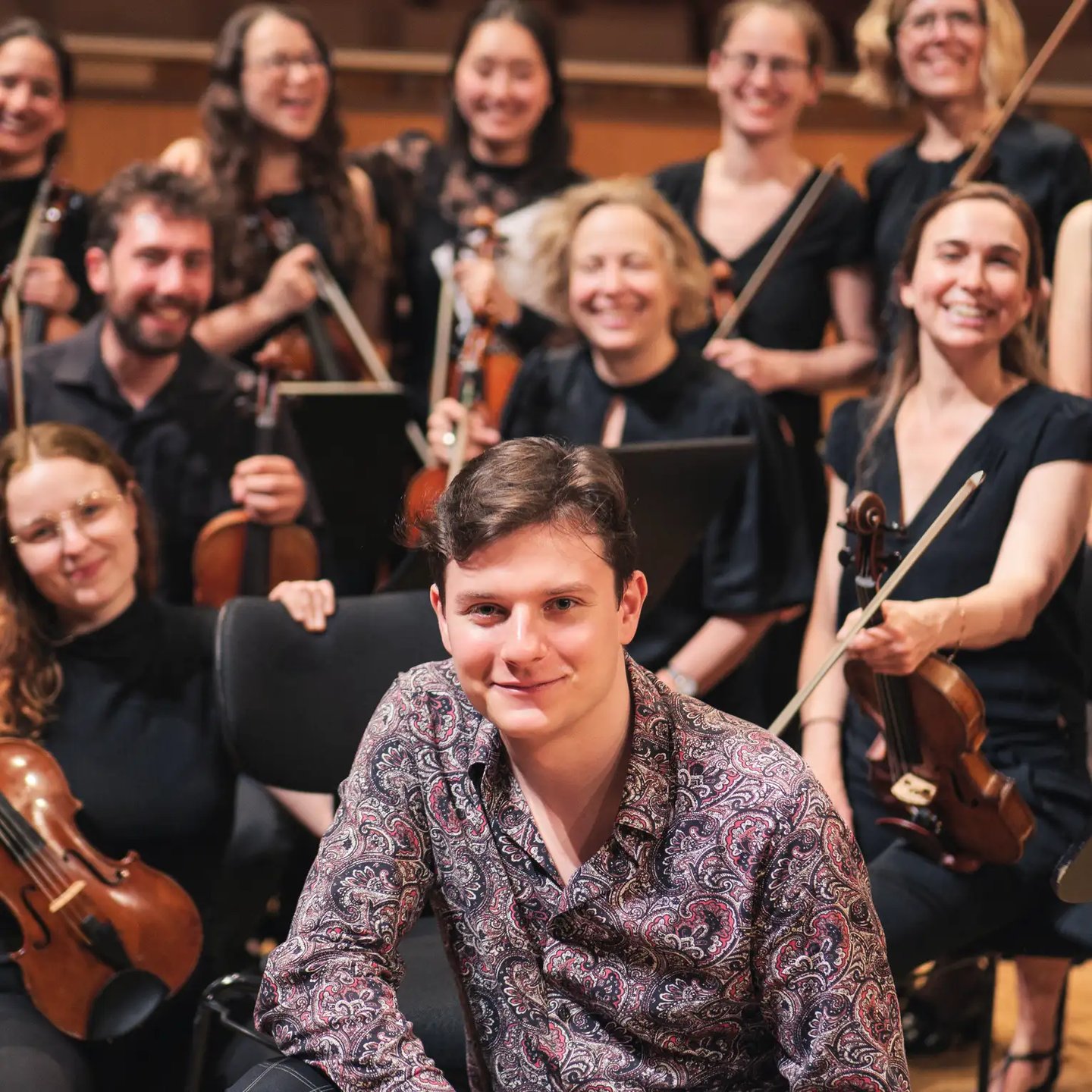
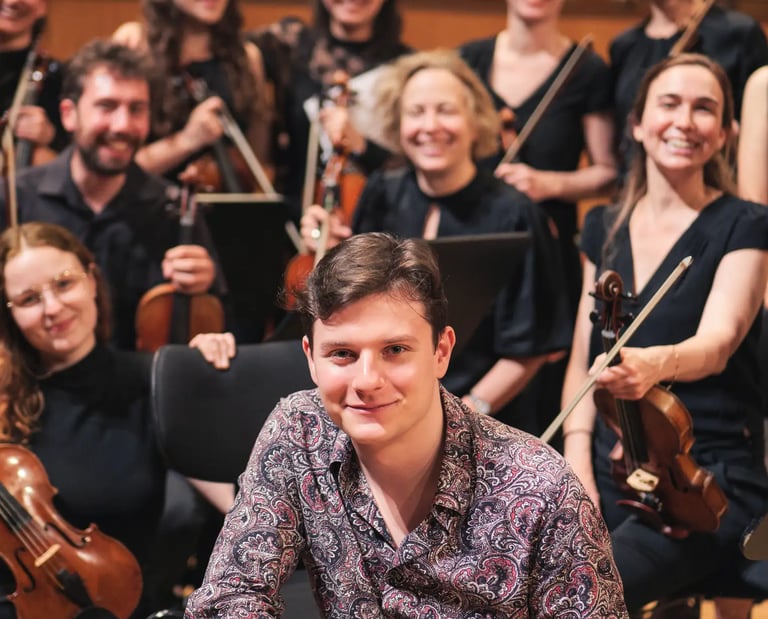
Kacper Madejek
Composer
About the Work, Process, and Narrative Arc
by Kacper Madejek
In this note, I would like to describe the composition, the process, and the narrative arc behind Terra Nova. I am grateful to Rafael Méndez for entrusting me with this work and for appreciating my process.
Rafael’s ideas and thoughtful prompts about destruction, violence, admonition, and renewal reminded me of the natural cycle in which things vanish and reappear, where one process leads to another in specific ways — whether gradually, like evolution or tectonic shifts, or more rapidly and violently, like climate change or natural catastrophes; there is action, and consequence. But Terra Nova, the new Earth, is also about exploration, reflection, and hope as we look into the future.
My main objective was to display the full gamut of the flute in a soloistic quasi–concerto fashion despite compacted instrumentation. Rafael mentioned that he wanted this work to become part of the standard repertoire, and so do I, but I also wanted to showcase his range and sensibility — from the lowest C to the highest C, from the faintest colored breath utterance to the loudest flutter-tongue shriek, from the most intricate intertwining sparkling textures, through cascading passages, to vanishing echoes and solo aeolian plaintive gestures reminiscent of the more lyrical cadenzas.
This world demands immediacy and reckless disposability, so as is often the case in my music, I strive to hold and reclaim our attention and provide an engaging listening experience with structural signposts and points of resonance. I constructed a series of colorful, interrelated sonic vignettes: independently strong as musical ideas and identities, yet animated by friction and contrast. Emotion becomes structural, and specific gestures and sound events collide with symbolic force. I was interested in exploring the fragility, indecisiveness, or maybe tenderness of gestures in the flute while maintaining variation and logical flow of ideas and intensity.
These themes permeate the piece from the very first gesture, where the piano uses non-triadic harmony, akin to that of Unquiet Times, a work Rafael had responded to, to “appear” from nowhere — or are we simply getting closer to something already there? The flute “fuses” with the piano like a morphed organism, creating a compound and playful timbre that foreshadows the deep dialogue between the two instruments throughout the work, with the flute acting as the dictating force.
This meandering opening presents vanishing echoes, like digital delay effects, to signify loss and retrospective reflection. Section A, in varied forms and lengths, functions as a suspended, fragile portal between other sections. From the very beginning, it also contains key rhythmic and motivic material — the innocuous flutter-tongue lick that will be transformed — that becomes the backbone of Section C on either side of the cadenza.
Section B — appearing at the two extremes of the piece — begins with a gentle, poignant minor aeolian cascade in interlocking upward gestures, where flute and piano move as a team. As the pleading/wailing fragment in the bass piano register is brought to our attention like a submerged monument, this uniformity quickly dissolves as the music grows violent, monstrous — almost catastrophic and psychotic — in B'. It is like a chase, or a desperate escape once it is too late. Strong, groovy pulses and a dramatic use of extreme low and high registers bring out the flute at its shrieking, most brutal. In B'', I deliberately sought to highlight this virtuosic, powerful, and dark side of the instrument, providing contrast with the highly lyrical passages that follow.
After a furtive conclusion, we awaken in A' — but this time the breather and reflection take us somewhere new, unveiling a tender and touching middle section. Here we are encouraged to meditate, with the piano’s bell-like repeated notes and an upbeat groove enriched by gentle polyrhythms that add variety to the unfolding harmony. The flute is revealed in several guises: from gentle lower lines and tremolos in C, to overblown harmonic and bird-like rhetorical gestures in C', to rapidly flowing, colorful runs in C''. The suspended codetta of C''' gives way to the cadenza-like aeolian passage in solo flute at the heart of the piece, like looking deep inward after attaining enough clarity. It feels vaguely familiar — melodic, but melancholic and poignant. The material is a variation on the C theme, subtly referencing folk ornamentation and prayer-like character.
This fragile introspection is abruptly and violently interrupted by flashbacks from the B sections — but only momentarily, before continuing the monodic line. It is as if time’s fabric had been torn — or perhaps the ghosts of the past, or future negligence, have intruded. Questions of what if arise as we return to Section C2, now featuring more bisbigliandos and trills, offering a moment of reassurance and closure. From there, we enter the portal of A3 — a reminder that the beauty surrounding us, as captivating as it may be, holds the potential to vanish into thin air, just like the gestures in flute and piano.
But just as we seem to be heading into the mournful cascading B section once more, our expectations are subverted: instead of collapse, we are met with a bright Ionian outburst of hope with sparkling interlocking upward gestures, as we look into the light — grand, resolved, and transformed on “new” — or simply renewed, rebuilt, and revitalized — Earth.
Follow on:
Texts and design by Rafael Méndez
© Rafael Mendez, 33139 Florida, United States
Trio Ivy
Creating musical experiences that extend beyond the concert hall.